
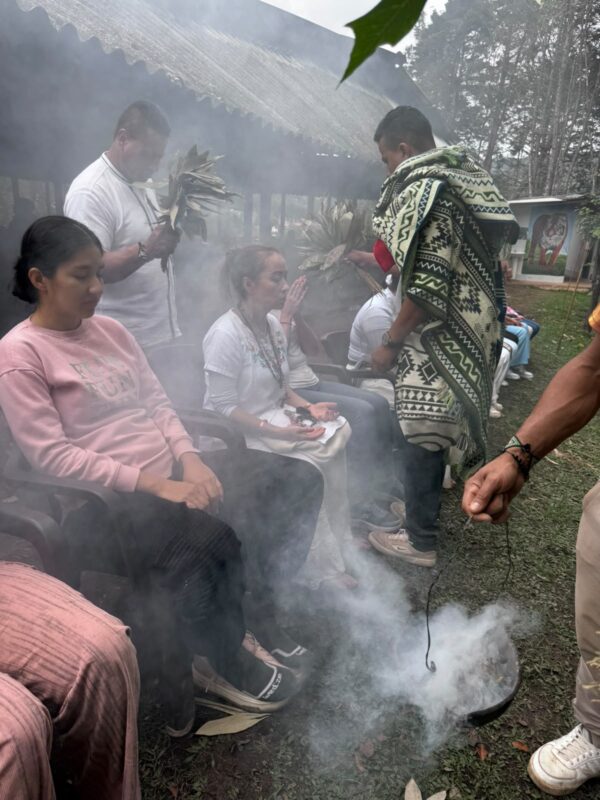
Colombia is one of the places in South America where the ancestral tradition of Ayahuasca, traditionally known as Yagé, continues to be practiced. For generations, Indigenous communities in regions such as Putumayo have preserved knowledge surrounding Yagé, its ceremonial use, traditional songs, preparation, and spiritual practices. Today, people from around the world travel to Colombia looking for an authentic Ayahuasca Ceremony in Colombia, hoping to experience this ancient tradition in a respectful and meaningful setting.
What Is an Ayahuasca Ceremony in Colombia?
An Ayahuasca ceremony in Colombia is traditionally understood as a ceremonial encounter with Yagé, a plant preparation associated with Indigenous traditions of the Colombian Amazon and Putumayo. The ceremony is not simply about drinking a plant preparation; traditionally, it is part of a broader cultural and spiritual practice involving the guidance of a Taita or traditional medicine practitioner, ceremonial songs, prayer, intention, and connection with nature.
In Putumayo, Yagé has been practiced for generations as part of Indigenous knowledge systems. Academic research describes the Taita as an important figure within the social and cultural structure surrounding Yagé ceremonies.
For international visitors, understanding this cultural context is important. An authentic ceremony should be approached with respect for the traditions, people, and communities that have preserved this knowledge over generations.
Yagé and Ayahuasca: Are They the Same?
The words Ayahuasca and Yagé are often used interchangeably, but terminology can vary depending on the region and tradition.
In Colombia, particularly in Putumayo, Yagé is the traditional name commonly used for the ceremonial medicine. The Colombian government tourism information for Putumayo also identifies Yagé and Ayahuasca as important symbols of the region’s cultural heritage.
For someone searching online, however, Ayahuasca is the term most commonly recognized internationally. This is why you may see expressions such as Ayahuasca ceremony Colombia, Ayahuasca retreat Colombia, and Ayahuasca near Medellín, while local practitioners may refer to the same tradition as a Yagé ceremony.
Who Guides an Ayahuasca Ceremony?
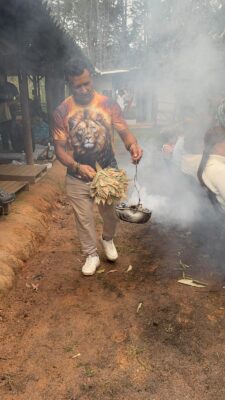
Traditionally, ceremonies are guided by a Taita, a term used in several Colombian Indigenous contexts for a traditional medicine practitioner. The Taita’s role goes beyond simply serving the medicine. Depending on the lineage and tradition, the ceremony may involve songs, prayers, cleansing practices, guidance, and maintaining the ceremonial space.
This traditional role is particularly associated with the Indigenous cultures of the Colombian Amazon and Putumayo.
When choosing an Ayahuasca ceremony in Colombia, visitors should take time to understand who is guiding the ceremony, their cultural background, their lineage, and how participants are accompanied before, during, and after the experience.
The Traditional Maloca
A Maloca is a traditional ceremonial space used by different Indigenous peoples of the Amazon and surrounding regions. In contemporary Yagé ceremonies, the Maloca can serve as the central space where participants gather, listen to ceremonial songs, receive the medicine, and remain throughout the experience.
The meaning and structure of a Maloca vary between Indigenous cultures and traditions. For this reason, it is important not to treat every Maloca as identical. What matters is that the space is approached respectfully and that visitors understand its cultural significance.
For someone looking for an authentic Ayahuasca ceremony in Colombia, experiencing the ceremony in a traditional ceremonial environment can provide a deeper connection to the cultural context of Yagé.
Why Putumayo Is Important to Yagé Tradition
Putumayo occupies a particularly important place in the history and contemporary practice of Yagé in Colombia. The region has longstanding Indigenous traditions connected to the medicine, and researchers have documented how Yagé has been practiced and transmitted within communities of the Putumayo-Caquetá region.
The growth of international interest in Ayahuasca has also brought challenges. Research from the Universidad Nacional de Colombia has examined how tourism and commercialization have affected traditional Yagé practices in Putumayo, including questions surrounding cultural authenticity and the recognition of traditional practitioners.
This makes cultural respect particularly important when choosing an Ayahuasca experience in Colombia.
Ayahuasca Ceremony Near Medellín
Although Yagé has deep roots in the Colombian Amazon, ceremonies can also take place in other parts of Colombia, including the Andean region near Medellín.
For international visitors, choosing an Ayahuasca ceremony near Medellín can make the experience more accessible while still allowing them to participate in a ceremony inspired by Colombian ancestral traditions.
At Psychotravels, our ceremony takes place in the Colombian Andes, surrounded by nature and away from the noise of Medellín. Our family has maintained the same sacred location for more than 38 years, creating a setting where visitors can experience Yagé within a family environment rather than a large commercial retreat center.
Our ceremonies are guided by an Indigenous Taita connected to the Pastos tradition and Putumayo, and take place in a traditional Maloca. We work with small groups so that participants can receive personal attention throughout the experience.
What Can You Expect From an Ayahuasca Ceremony?
Every person’s experience is different, and there is no way to predict exactly what someone will experience during a ceremony.
Participants may experience intense emotions, introspection, changes in perception, memories, visions, physical sensations, or moments of profound personal reflection. Some people describe the experience as challenging, while others experience moments of peace, connection, or emotional release.
It is important not to approach Ayahuasca with the expectation of receiving a specific result.
Instead, many people choose to approach the experience with an open mind, humility, and a personal intention.
The ceremony itself is only one part of the experience. Preparation, appropriate support, and time for reflection afterward can also be important.
How to Prepare for an Ayahuasca Ceremony in Colombia
Preparation should begin before arriving at the ceremony.
Visitors should provide the facilitator or retreat team with accurate information about medications, medical conditions, mental health history, and other relevant health considerations. Ayahuasca can interact with certain medications and may not be appropriate for everyone.
A responsible ceremony provider should therefore have a clear screening and preparation process rather than simply accepting every participant.
Physical preparation may also include avoiding alcohol and recreational drugs and following the specific dietary recommendations provided by the ceremony organizers.
Most importantly, preparation should include understanding what the ceremony is — and what it is not. Ayahuasca should not be considered a guaranteed treatment or cure for a medical or psychological condition.
Choosing an Authentic Ayahuasca Ceremony in Colombia
With the growing international popularity of Ayahuasca, there are now many different types of ceremonies and retreats available throughout Colombia.
When researching an Ayahuasca ceremony in Colombia, consider asking:
- Who guides the ceremony?
- What Indigenous tradition or lineage do they follow?
- Where does the ceremony take place?
- Is the ceremony held in a traditional Maloca?
- How large are the groups?
- What preparation is provided before the ceremony?
- Who accompanies participants during the ceremony?
- Is there support available afterward?
- Does the organization clearly explain contraindications and safety considerations?
- Is the experience based on an established tradition or primarily designed for tourism?
These questions can help visitors distinguish between a culturally grounded ceremony and an experience created primarily for the growing Ayahuasca tourism market.
Our Ayahuasca Ceremony Near Medellín
For more than 38 years, Psychotravels has maintained its ceremonial tradition in the same sacred location in the Colombian Andes near Medellín.
This is not a retreat center created specifically for tourism. It is a family place where our Indigenous Taita grew up and where his family continues to live. Our ceremonies are held in a traditional Maloca, surrounded by the mountains and nature of the Colombian Andes.
We work with small groups, allowing our Taita and facilitators to provide personal attention throughout the experience. Our approach is rooted in respect for ancestral traditions, family heritage, the land, and the cultural importance of Yagé.
For travelers searching for an authentic Ayahuasca ceremony in Colombia, an Ayahuasca ceremony near Medellín, or an Ayahuasca retreat in Colombia, our intention is to offer an experience connected to Colombian tradition rather than a generic wellness retreat.
Frequently Asked Questions
Is Ayahuasca legal in Colombia?
The legal status and regulation surrounding Ayahuasca can be complex and may depend on the circumstances, location, and applicable Colombian laws. Visitors should obtain current legal information and choose providers who operate responsibly.
Is Ayahuasca the same as Yagé?
Ayahuasca and Yagé are often used to refer to related ceremonial plant preparations. In Colombia, particularly in Putumayo, Yagé is the traditional term widely associated with the practice.
Where can I experience an Ayahuasca ceremony in Colombia?
Ceremonies take place in different regions of Colombia. Putumayo is particularly associated with Indigenous Yagé traditions, while ceremonies are also available in other regions, including the Colombian Andes near Medellín.
What is a Maloca?
A Maloca is a traditional ceremonial structure associated with various Indigenous peoples of the Amazon and surrounding regions. In Yagé ceremonies, it can serve as the central ceremonial space.
What should I look for in an Ayahuasca retreat in Colombia?
Look for transparency about the guide’s background and tradition, group size, preparation, participant support, location, safety procedures, and the cultural context of the ceremony.
Final Thoughts
An Ayahuasca Ceremony in Colombia can be much more than a travel experience. Yagé has a long and complex cultural history in Colombia, particularly in Putumayo, where Indigenous communities have preserved ceremonial traditions across generations.
For visitors who choose to explore this tradition, the most important starting point is respect — respect for the medicine, the Indigenous traditions from which it comes, the people who preserve those traditions, and the responsibility involved in creating a safe ceremonial environment.
we invite visitors to discover this tradition in the Colombian Andes near Medellín, in a family environment that has preserved its ceremonial location for more than 38 years.
This blog has been written by Orion Gomez, one of the most experienced Ayahuasca facilitators, who works closely alongside our shaman from the Pasto tradition in Putumayo. With over 37 years of experience in this sacred land, our team is deeply rooted in ancestral wisdom and dedicated to providing a safe, authentic, and respectful ceremonial space.

do you want to enjoy an ayahuasca ceremony with us : clik here
